
Japan Achieves a World-First Energy Breakthrough
In a major leap for global energy innovation, Japan has announced a groundbreaking achievement that could reshape how the world generates and consumes power. Scientists and engineers in Japan have successfully demonstrated a new form of energy production that promises to be cleaner, safer, and virtually limitless.
The Breakthrough Explained
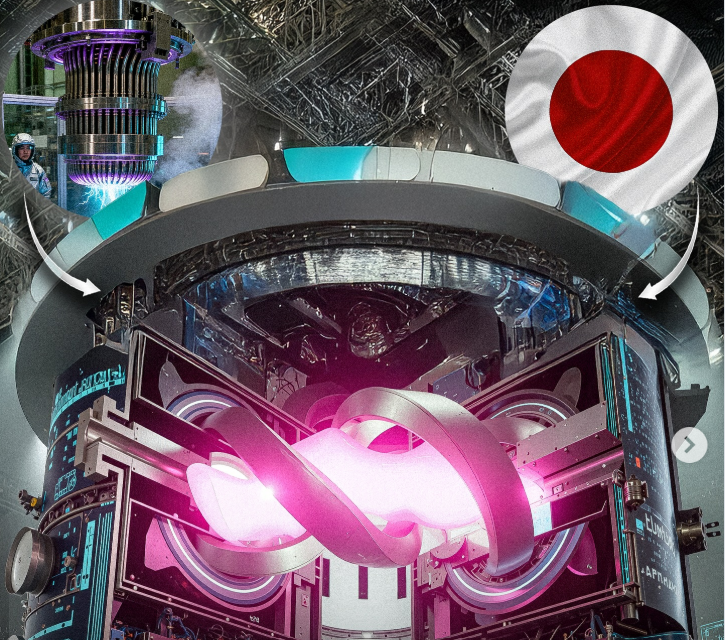
The milestone centers around advancements in nuclear fusion—the same process that powers the Sun. Unlike traditional nuclear fission, fusion works by combining atomic nuclei to release massive amounts of energy without producing long-lived radioactive waste.
Japanese researchers have managed to sustain a stable fusion reaction for a longer duration than ever before while maintaining the conditions necessary for net energy gain. This means the system produced more energy than it consumed—something scientists have been striving toward for decades.
The Technology Behind the Success
At the heart of this breakthrough is a sophisticated device known as a tokamak reactor, specifically the JT-60SA, one of the most advanced fusion experiments in the world.
This reactor uses powerful magnetic fields to contain plasma heated to millions of degrees—hotter than the core of the Sun. Maintaining stability at such extreme temperatures has long been one of the biggest challenges in fusion research, and Japan’s success marks a critical step forward.
Why This Matters for the World
This development could significantly accelerate the global transition away from fossil fuels. Fusion energy offers several major advantages:
- Clean Energy: No carbon emissions during operation
- Abundant Fuel: Uses isotopes of hydrogen found in water
- Safety: No risk of meltdown like traditional nuclear reactors
- Minimal Waste: Produces far less radioactive material
Countries around the world, including partners in the ITER project, are racing to make fusion commercially viable—and Japan’s progress could bring that reality closer than ever.
Economic and Environmental Impact

If scaled successfully, this technology could dramatically reduce global energy costs and dependence on oil and gas. It also offers a powerful tool in the fight against climate change, helping nations meet ambitious carbon neutrality targets.
For a country like Japan, which has limited natural energy resources and relies heavily on imports, this breakthrough strengthens energy security and independence.
Challenges Still Ahead
Despite the excitement, experts caution that commercial fusion power plants are still years away. Key challenges include:
- Scaling up the technology for continuous energy production
- Reducing costs of construction and maintenance
- Developing materials that can withstand extreme conditions
However, with each breakthrough, the timeline becomes shorter and more achievable.
A Glimpse Into the Future
Japan’s achievement represents more than just a scientific milestone—it’s a glimpse into a future where clean, limitless energy powers the world. As research continues and global collaboration grows, the dream of fusion energy is rapidly moving from theory to reality.
The world is watching closely, and if progress continues at this pace, the next energy revolution may already be underway.