 11
11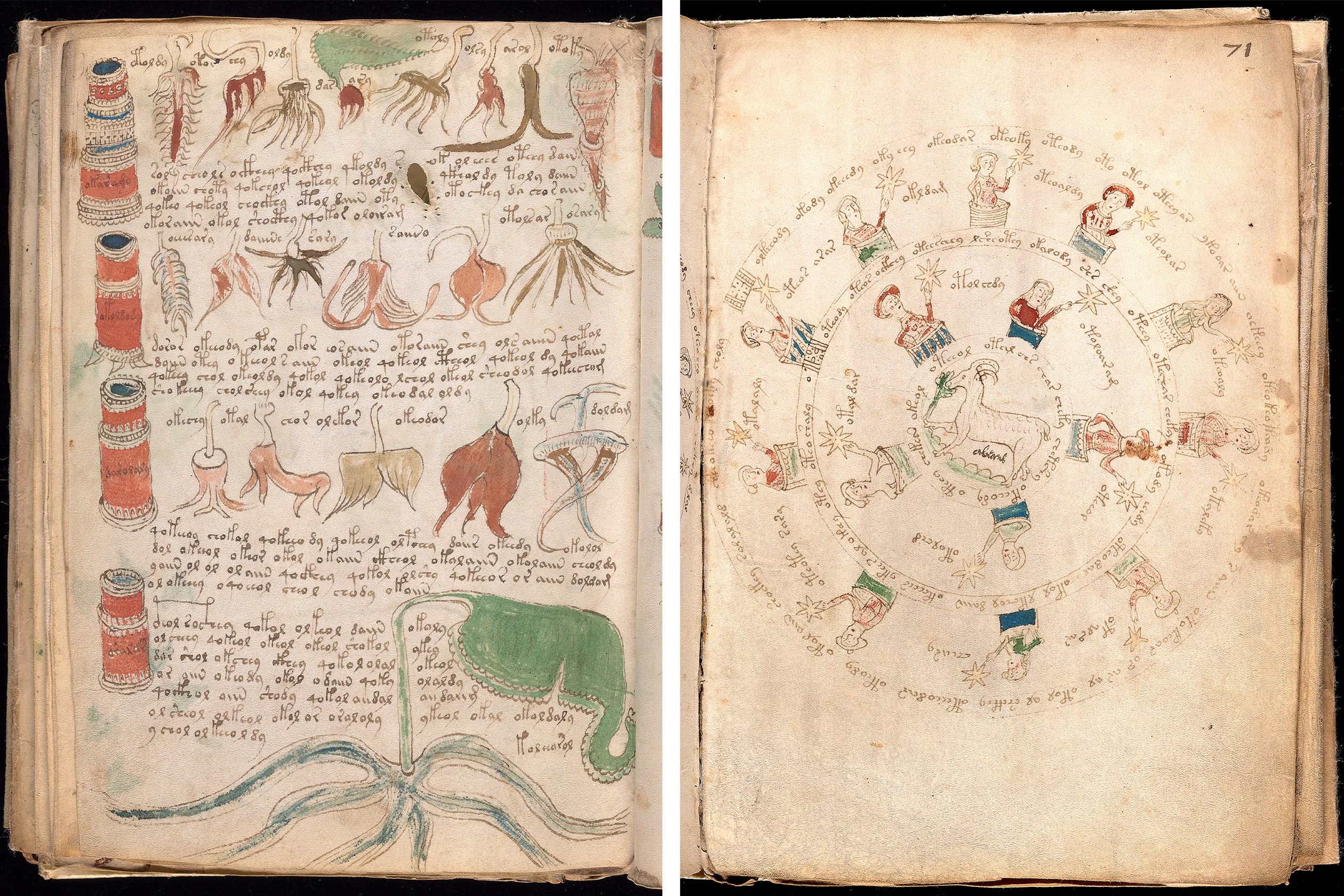
The Voynich Manuscript is one of the most puzzling books in human history. Dating to the early 15th century, this handwritten codex is filled with strange illustrations and written in a script that no one has been able to definitively decipher. Despite more than a century of modern study—and likely centuries of earlier curiosity—its language, purpose, and author remain unknown.
Although the manuscript was created around 1404–1438 (based on radiocarbon dating of the parchment), it only became widely known in 1912. That year, a Polish book dealer named Wilfrid Voynich purchased it from a Jesuit college in Italy. The manuscript later took his name.
Today, the book is housed at Yale University, in the Beinecke Rare Book & Manuscript Library, where it is preserved as one of the institution’s most famous treasures.
The Voynich Manuscript is about 240 surviving pages long (though some pages are missing). It is written on vellum and richly illustrated with colorful drawings. The book appears to be divided into several sections based on its imagery:
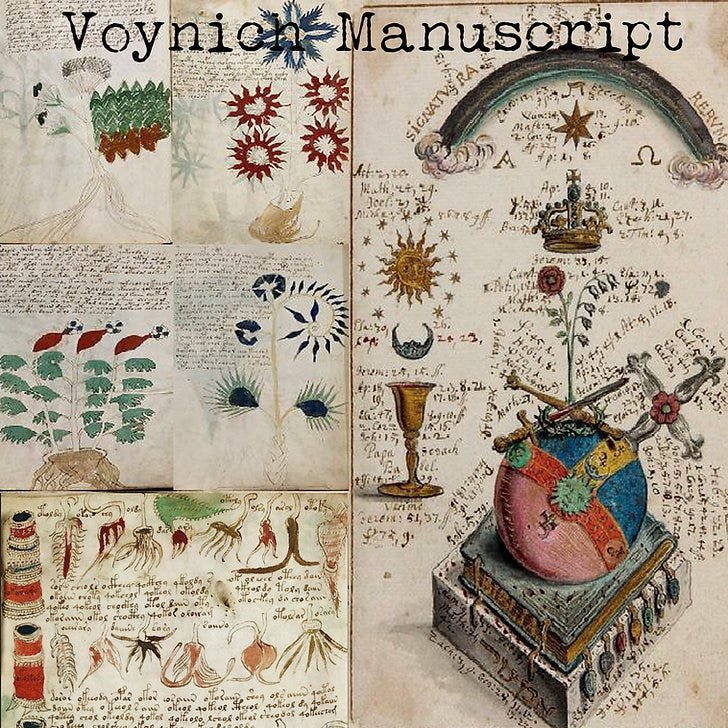
Many pages contain drawings of plants, most of which do not match any known species. Some resemble real plants but are combined in impossible ways, as if the artist blended multiple species into one.
Circular diagrams depict stars, zodiac symbols, and what appear to be astronomical charts. Zodiac signs such as Aries and Pisces are illustrated, often surrounded by small nude female figures.
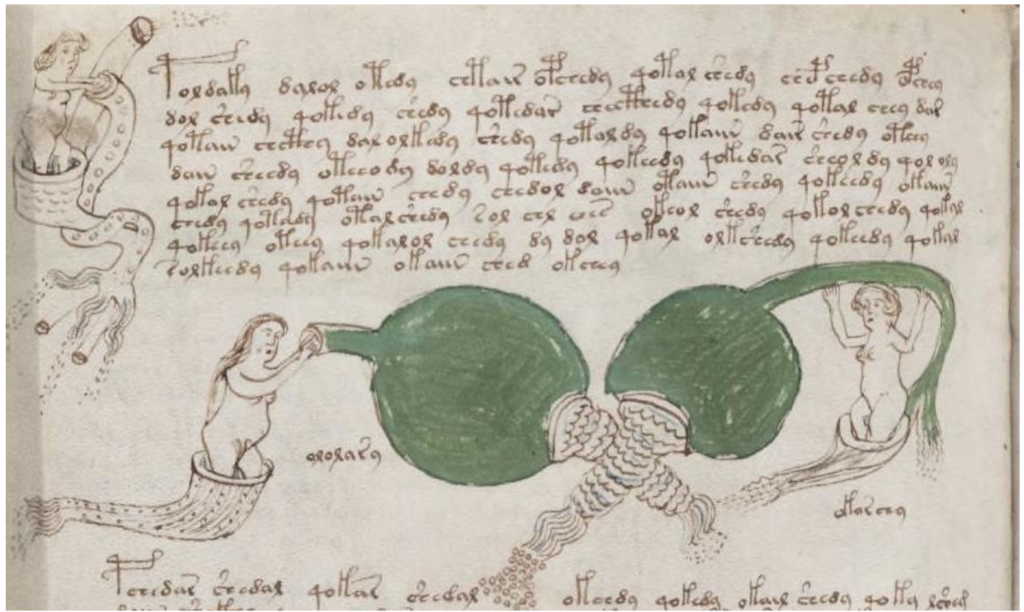
This section includes unusual imagery of nude women bathing in green liquid or interacting with strange tubes and vessels. Some researchers believe this could represent medical or alchemical processes.
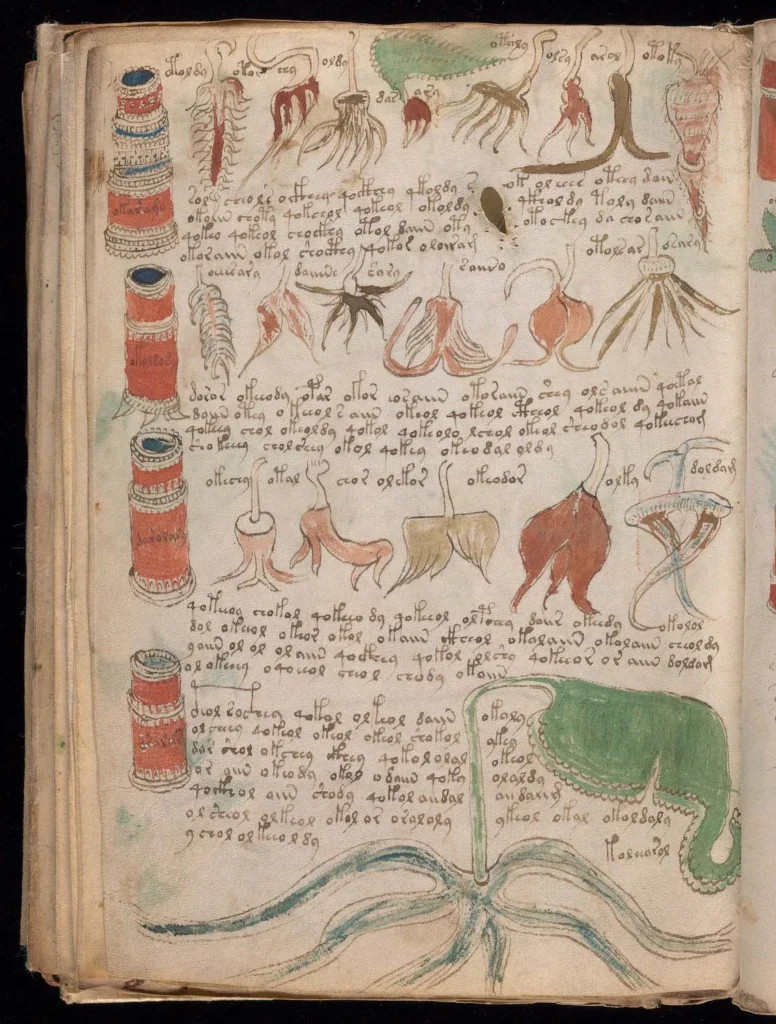
Drawings of plant parts—roots, leaves, and jars—suggest medicinal preparation. The containers resemble apothecary vessels from medieval Europe.
The most perplexing feature of the manuscript is its script. The writing flows smoothly from left to right and appears carefully structured, with repeating patterns that resemble natural language. However:
During both World Wars, expert codebreakers attempted to decipher the text—without success. Statistical analysis shows the text has patterns consistent with real languages, leading some scholars to believe it encodes meaningful content rather than random gibberish.
Over the years, many theories have emerged about who wrote the manuscript and why.
Some once believed it was written by Roger Bacon, a medieval English philosopher and scientist known for experimental thinking. However, carbon dating places the manuscript about a century after his death.
Given the botanical and biological illustrations, many scholars think it could be a medical, herbal, or alchemical manual written in code to protect secret knowledge.
Some skeptics argue that the manuscript could be a sophisticated hoax, possibly created to deceive wealthy collectors. However, producing such a complex and linguistically consistent text would have required immense effort.
In recent decades, researchers have used advanced tools to study the manuscript:
Despite these advances, no interpretation has gained universal acceptance.
The Voynich Manuscript sits at the crossroads of history, linguistics, art, cryptography, and mystery. It challenges our confidence in our ability to decode the past. In an age where nearly every ancient script—from Egyptian hieroglyphs to Mayan glyphs—has been deciphered, this manuscript remains silent.
Its enduring mystery invites both scholarly investigation and imaginative speculation. Whether it is a coded scientific treatise, an invented language, or something else entirely, the Voynich Manuscript continues to captivate researchers and dreamers alike.
More than 600 years after it was written, it still refuses to give up its secrets.