 11
11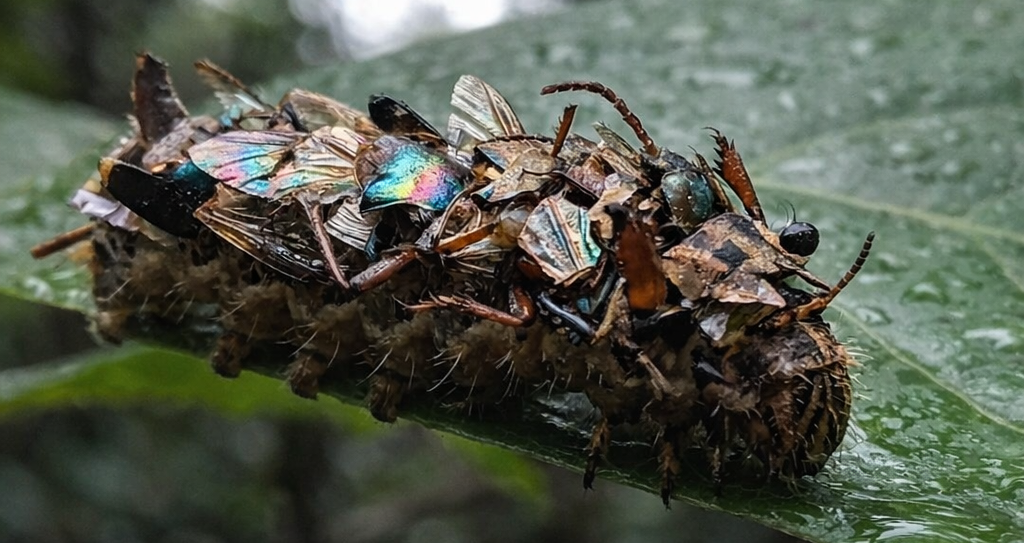
Deep within the forests of Hawaii, scientists have uncovered one of the most bizarre and unsettling creatures ever documented—a caterpillar that doesn’t just hunt other insects, but turns their remains into armor.
Nicknamed the “bone collector,” this rare species has stunned researchers with behavior that feels more like something out of a horror film than the natural world.
The discovery was made by a team of scientists from the University of Hawaiʻi at Mānoa, who were studying insect life in remote forest ecosystems. While examining spider webs, they noticed something unusual—a small caterpillar covered in what appeared to be fragments of dead insects.
At first glance, it looked like debris stuck to its body. But closer inspection revealed something far more disturbing.
Unlike most caterpillars, which are herbivores feeding on leaves, this species is carnivorous. It actively hunts trapped insects in spider webs—particularly those caught by spiders but not yet consumed.
Once it finds its prey, the caterpillar:
This process creates a macabre suit of armor made from heads, wings, and other insect parts.
This gruesome disguise serves a critical purpose—survival.
By covering itself in insect remains, the caterpillar:
Incredibly, this strategy allows the caterpillar to live undetected right inside a spider’s web—one of the most dangerous places for an insect.
Most insects avoid spider webs at all costs. But this caterpillar does the opposite—it thrives there.
It moves slowly and deliberately, blending in with the remains of previous victims. The stitched-on body parts act like both armor and invisibility cloak, helping it avoid becoming the spider’s next meal.
This behavior is so rare that scientists consider it unlike anything else observed in the insect world.
Researchers believe this caterpillar belongs to a unique and ancient lineage found only in Hawaii. Its isolation on the islands may have driven the evolution of such an extreme survival strategy.
Because of habitat loss and environmental changes, the species is thought to be incredibly rare—and potentially at risk of disappearing before we fully understand it.
The “bone collector” caterpillar is a powerful reminder that evolution doesn’t always produce beauty in the traditional sense. Sometimes, survival leads to strategies that are strange, eerie, and even disturbing.
Yet, beneath the shock factor lies a remarkable example of adaptation:
The discovery of this armor-wearing caterpillar challenges everything we think we know about these seemingly simple creatures. Far from being harmless leaf-eaters, some caterpillars have evolved into cunning predators with survival tactics that rival those of much larger animals.
In the hidden corners of the natural world, evolution continues to surprise us—proving that even the smallest creatures can have the most extraordinary and haunting stories.