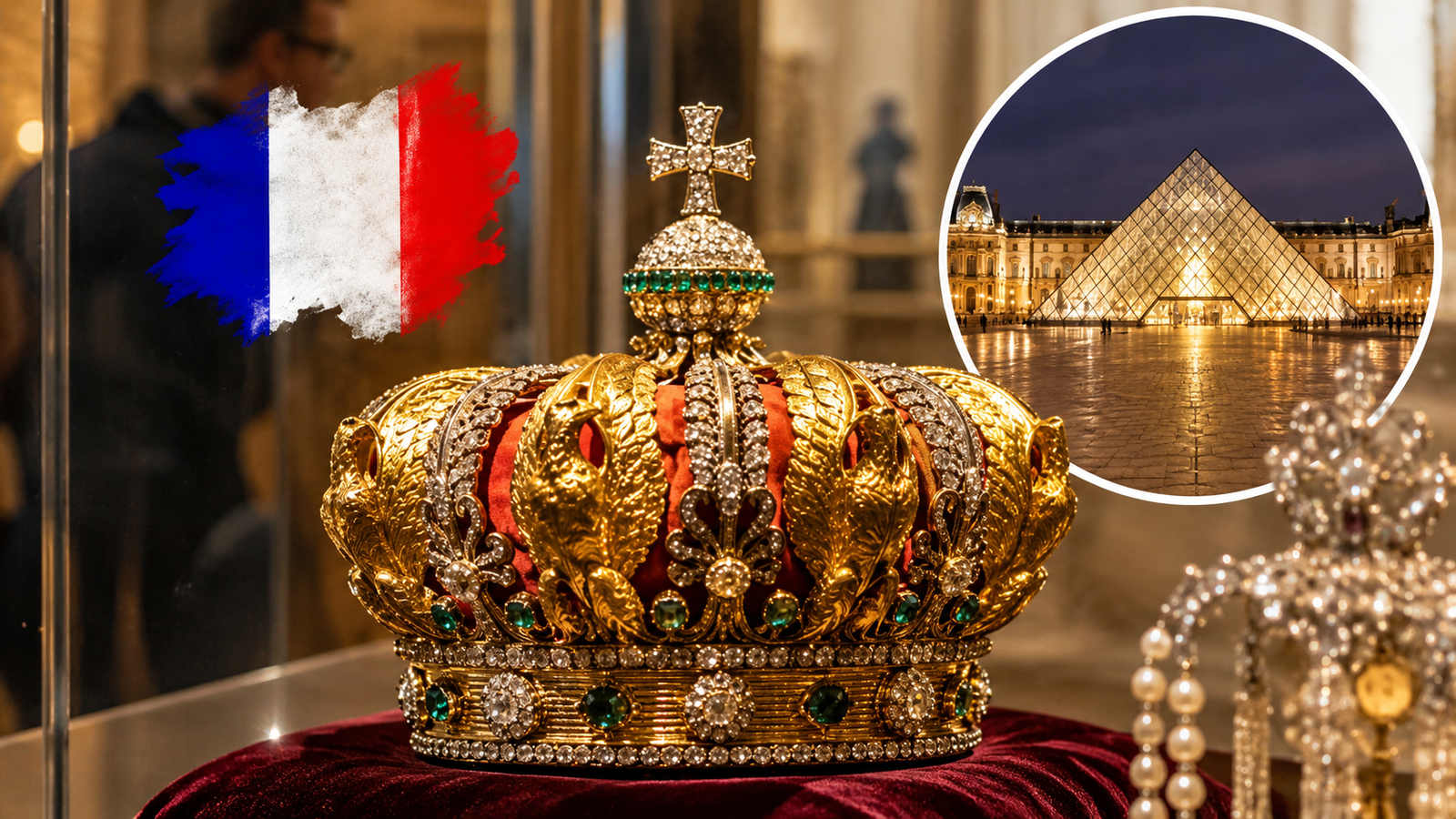
The Louvre Heist: A Daylight Robbery That Shocked the World
Imagine walking into one of the world’s most famous museums on a Sunday morning. Tourists are taking photographs, visitors are exploring historic collections, and security guards are watching over priceless treasures.
Suddenly, a group of criminals arrives outside the building. They use industrial equipment to reach an upper-floor window, break into a gallery, smash display cases, and steal some of France’s most valuable royal jewelry.
Within minutes, they disappear.
This sounds like a scene from a Hollywood crime movie. However, it happened in real life.
On October 19, 2025, thieves carried out a remarkable robbery at the Louvre Museum in Paris, France. They escaped with eight pieces of historic jewelry valued at approximately €88 million, or around $102 million at the time.
The robbery took less than eight minutes from beginning to end. It also raised serious questions about museum security and the protection of priceless historical objects.
More than a year later, the stolen jewelry remains missing.
So, how did the criminals manage to pull off such an operation in broad daylight? And what happened to the missing royal treasures?
Let’s examine the facts.
1. How the Eight-Minute Robbery Happened
The robbery took place on Sunday morning, October 19, 2025.
According to the Paris prosecutor’s office, the museum had opened to visitors only 30 minutes earlier when the thieves arrived at approximately 9:34 a.m.
The criminals approached the building from the Seine River side. They used a truck equipped with a mechanical lifting platform to reach a first-floor balcony.
Several members of the group wore high-visibility yellow vests, making their appearance similar to that of construction or maintenance workers.
Two men climbed towards the balcony while their accomplices remained outside.
After reaching the building, the intruders broke a window and entered the Apollo Gallery, which houses important French royal treasures.
Inside, they used power tools to break into two jewelry display cases.
They quickly collected the jewelry and left the gallery at approximately 9:38 a.m.
The group escaped on two motor scooters.
The entire operation took less than eight minutes, with the thieves spending fewer than four minutes inside the museum.
Fortunately, no visitors or museum employees suffered injuries.
However, the damage to France’s cultural heritage was enormous.
2. What Did the Thieves Steal?
The criminals did not target ordinary museum souvenirs or modern jewelry.
They selected historic pieces connected to French queens and empresses.
According to the Louvre and the Paris prosecutor’s office, eight pieces of jewelry were stolen.
These included:
The Marie-Amélie and Hortense collection
- A sapphire tiara.
- A sapphire necklace.
- One sapphire earring from a matching pair.
The Marie-Louise collection
- An emerald necklace.
- One emerald earring from a matching pair.
The Empress Eugénie collection
- A diamond and gemstone brooch known as the reliquary brooch.
- A magnificent diamond and pearl tiara.
- A large diamond corsage-bow brooch.
These objects represented an important part of France’s royal and imperial history.
Their value was not limited to the diamonds, emeralds, sapphires, gold and pearls used to create them. They also carried historical significance because of their connections to important figures from the country’s past.
On October 21, 2025, Paris prosecutor Laure Beccuau announced that the financial value of the stolen jewelry was estimated at €88 million.
However, she also explained that the historical value of these objects could not be measured in money.
3. The Damaged Crown of Empress Eugénie
One of the most unusual details of the robbery involved the crown of Empress Eugénie.
During their escape, the criminals attempted to take the crown through a narrow opening in a damaged display case. The crown became badly damaged during the incident.
The thieves eventually abandoned it during their escape.
Police recovered the crown near the museum.
Although the object survived, it suffered significant damage. Its condition became another painful reminder of what happened inside the Apollo Gallery that morning.
The crown was not part of the eight pieces that remained missing. It was recovered and subsequently examined by specialists.
This detail makes the robbery even more extraordinary. The criminals managed to steal millions of euros worth of historical jewelry, yet their hurried escape also resulted in damage to another priceless royal object.
4. How Could This Happen at the Louvre?
Perhaps the biggest question following the robbery was how criminals could enter such a famous museum during normal visiting hours.
The Louvre attracts millions of visitors every year. It houses some of the world’s most important artworks and historical collections.
People naturally expect a museum of this importance to have strong security.
However, the robbery exposed serious weaknesses in the museum’s security arrangements.
The thieves used a lifting platform to reach an upper-floor window. They then broke through the window and attacked the display cases using power tools.
The incident raised questions about several areas of security:
- The protection of external walls and windows.
- The placement and coverage of surveillance cameras.
- The speed of the security response.
- The protection of valuable objects during public opening hours.
- The coordination of security systems and personnel.
The robbery also attracted criticism from employees and labour unions, who had previously raised concerns about staffing and the condition of the museum.
French authorities subsequently announced investigations into the circumstances surrounding the incident.
It is important to understand that the exact technical failures should not be assumed without official evidence. However, the robbery clearly demonstrated that even a world-famous institution can face serious security risks.
5. The Investigation and the Arrests
French authorities launched a major investigation immediately after the robbery.
The Paris prosecutor’s office assigned the case to specialist police units dealing with organised crime and cultural property theft.
Investigators examined surveillance footage, searched for forensic evidence and followed the suspected escape routes.
They also examined equipment abandoned by the criminals.
The investigation eventually led police to several suspects.
By November 28, 2025, French prosecutors had announced that the fourth man believed to have been present during the robbery had also been formally charged.
The investigation involved a wider group of people, and authorities examined whether anyone else had helped organise or support the operation.
However, being charged does not mean that a person has been convicted. The suspects remain entitled to the presumption of innocence until a court determines their guilt.
The investigation continued as authorities tried to establish exactly what happened to the missing jewelry.
6. The Mystery of the Unknown Mastermind
One of the most interesting developments came from the later questioning of two main suspects.
In July 2026, French newspaper Le Monde published details from their statements to investigating judges.
According to the newspaper’s reporting, the suspects described being recruited shortly before the robbery. They claimed that someone had organised the operation and promised them payment for carrying it out.
One suspect reportedly said he expected to receive between €15,000 and €20,000, while the other described a payment of between €20,000 and €25,000.
The suspects also described a meeting in an underground parking area after the robbery.
One of them claimed that the person receiving the jewelry was disappointed because the thieves had not taken more.
These statements introduced another possible dimension to the case.
Were the men simply carrying out a robbery for financial gain, or were they working for someone with access to a wider criminal network?
Investigators have considered the possibility that other individuals helped organise the operation or receive the stolen jewelry.
However, the existence and identity of a mastermind have not been conclusively established.
The suspects’ statements are part of the investigation, not proof of every allegation they contain.
7. The Famous Diamonds That Were Left Behind
There is another remarkable detail about the robbery.
Despite stealing eight pieces of royal jewelry, the criminals left some of the Louvre’s most famous diamonds behind.
These included:
- The Regent Diamond.
- The Sancy Diamond.
- The Hortensia Diamond.
The Regent Diamond is particularly famous for its size and history. It is one of the most important diamonds in the French Crown Jewels collection.
The fact that these famous treasures remained at the museum shows that the thieves focused on the jewelry inside the display cases they targeted rather than taking everything of value.
Their operation was extremely quick, and they had very little time to search the entire gallery.
The robbery therefore left behind a strange contrast: some historic treasures disappeared, while other famous diamonds remained untouched.
8. The Louvre Director’s Resignation
The robbery also had serious consequences for the museum’s leadership.
Laurence des Cars, who served as the Louvre’s director, faced growing criticism following the incident.
Questions about the museum’s security, management and infrastructure became part of a wider public debate.
In February 2026, she resigned from her position.
Her departure reflected the enormous pressure facing the institution after the theft.
The museum later appointed Christophe Leribault as its new director.
The Louvre also began strengthening its security arrangements, including additional surveillance cameras and anti-intrusion systems.
These changes formed part of a wider effort to modernise the historic institution.
9. Where Are the Missing Jewels Today?
This is perhaps the biggest mystery surrounding the entire case.
More than a year after the robbery, the eight stolen pieces of jewelry have still not been recovered.
According to reporting published by AFP on October 20, 2026, the four main suspects were in custody awaiting trial, but investigators had made little progress in locating the missing treasures.
One possible explanation is that the jewelry remains hidden somewhere in France.
Another possibility is that the objects were handed to other people who specialise in handling stolen valuables.
Investigators have also had to consider a more disturbing possibility: that criminals could dismantle the jewelry and sell the precious stones separately.
Such an operation would make recovery much more difficult.
However, these remain possibilities rather than confirmed explanations.
The last known investigative leads have included surveillance footage from an underground parking area in Aubervilliers, where investigators believe the jewelry may have passed through after the robbery.
Authorities have continued searching for information that could reveal the location of the missing objects.
The jewelry also remains listed in international stolen-art databases.
10. The Apollo Gallery Opens Again
On July 22, 2026, the Louvre’s Apollo Gallery reopened to visitors.
However, visitors returning to the historic room could not see the stolen royal jewelry.
The museum had removed the former displays, and the gallery reopened without the missing treasures.
Visitors could still admire its impressive architecture, decorated ceilings and historical artwork.
The reopening represented an important step towards restoring normal operations at the museum.
But the missing jewelry remains a reminder of what happened on October 19, 2025.
The Louvre has strengthened its security, but the questions surrounding the robbery have not disappeared.
Conclusion: Will France Ever Recover Its Missing Crown Jewels?
The Louvre robbery was more than an ordinary theft.
It involved historic treasures, a carefully organised operation and serious questions about the security of one of the world’s most famous museums.
Eight pieces of French royal jewelry disappeared in less than eight minutes.
The damaged crown of Empress Eugénie was recovered, suspects were arrested, and the museum introduced additional security measures.
Yet the most important question remains unanswered.
Where are the eight missing pieces of jewelry?
Are they hidden somewhere in France? Have they passed into the hands of an international criminal network? Or have they already been dismantled and sold?
As of November 2026, investigators have not publicly confirmed their location.
These objects survived generations of French history, but their future remains uncertain.
What do you think happened to the missing royal jewelry? Could it still be hidden somewhere, waiting to be discovered, or has it disappeared forever?
Follow Mystery Archive for more documented mysteries, unusual crimes and real cases from around the world.